
Enter whole numbers. The calculator finds the greatest common factor and reduces the fraction to lowest terms.
Simplify Fractions is one of those skills that feels tricky until someone shows you the trick, and then it clicks. If you have ever finished a math problem with an answer like 18/24 and wondered whether it is “done,” you are not alone. This guide walks you through the idea in plain language so you can tidy up any fraction with confidence.
What Does It Mean to Simplify a Fraction?
To simplify a fraction means rewriting it with smaller numbers while keeping its value the same. Think of a pizza cut into 8 slices. If you eat 4 of them, you have eaten 4/8 of the pizza, which is the same as eating half. Writing it as 1/2 tells the same story with simpler numbers. This is what it means to reduce a fraction to lowest terms, where the top and bottom numbers share no common factor except 1. Students often use Simplify Fractions as a first skill before tackling adding or multiplying fractions.
How to Simplify Fractions Step by Step
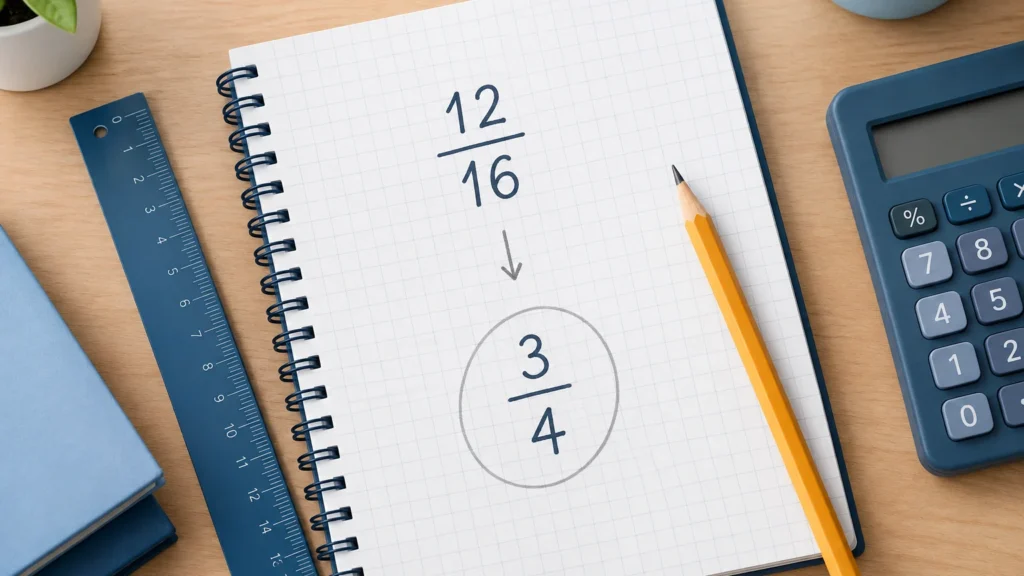
Simplifying is a three-part process. First, find the greatest common factor (GCF) of the numerator and denominator. Then divide both numbers by that factor. Finally, check that nothing else divides evenly into both. Work through the steps below and you will reach the answer in lowest terms every time.
- List the factors. Write the factors of the numerator and the denominator. For 12 and 18, that gives 1, 2, 3, 4, 6, 12 and 1, 2, 3, 6, 9, 18.
- Find the greatest common factor. Pick the largest number that appears in both lists. Here, that is 6.
- Divide both parts. Divide the numerator and the denominator by the GCF. 12 ÷ 6 = 2 and 18 ÷ 6 = 3, so 12/18 becomes 2/3.
- Check your answer. Confirm that 2 and 3 share no factor other than 1. If they do, repeat the division.
Simplifying Fractions with Examples
Practice makes this skill stick, so let’s work through a few examples from easy to harder. Start with 6/8. Both numbers divide by 2, giving 3/4, and no common factor is left.
Next, try 36/84. Break each number into prime factors: 36 = 2 × 2 × 3 × 3 and 84 = 2 × 2 × 3 × 7. The shared factors are 2, 2, and 3, so divide out 12 to get 3/7.
Improper fractions work the same way. For 45/18, the shared factor 9 leaves 5/2, which you can write as the mixed number 2 1/2.
- 6/8 becomes 3/4 (divide by 2)
- 36/84 becomes 3/7 (divide by 12)
- 45/18 becomes 5/2, or 2 1/2 (divide by 9)
Common Mistakes and Quick Comparison of Methods
Two methods work well for reducing a fraction. Dividing by the greatest common factor finishes in one step once you find that factor. Repeated division by small primes is slower but easier to track when the numbers are small. Choose the one that fits the numbers in front of you.
| Method | Best for | Main drawback |
|---|---|---|
| Divide by the greatest common factor | Larger numerators and denominators | Finding the factor can take extra effort |
| Repeated division by small primes | Smaller numbers you can check quickly | Takes several steps |
Learners often make a few predictable errors. They divide only the numerator or only the denominator, which changes the value. They subtract the common factor instead of dividing by it. They stop before the fraction is in lowest terms, or they cancel terms that are added rather than multiplied.
Key Takeaways
- To simplify a fraction, divide the numerator and denominator by their greatest common factor until nothing else divides evenly into both.
- A fraction in lowest terms has a numerator and denominator with no common factor other than 1.
- You can simplify step by step by dividing by small common factors, then checking again until the fraction cannot be reduced further.
- Simplifying first usually makes later math, such as adding or multiplying fractions, easier and less error-prone.
Frequently Asked Questions About Simplify Fractions
How do you know when a fraction is fully simplified?
A fraction is fully simplified when the numerator and denominator share no common factor except 1. Check by listing the factors of each number or by asking whether any number larger than 1 divides evenly into both. If none does, the fraction is in lowest terms and needs no further reduction.
Can you simplify a fraction without finding the greatest common factor?
Yes. You can divide by any common factor, such as 2, 3, or 5, one at a time, and keep going until no common factor remains. This takes a few more steps than dividing by the greatest common factor at once, but it reaches the same lowest-terms answer.
Do you simplify before or after adding fractions?
You can do either, but simplifying first often makes the work smaller. Reducing the fractions before you add them keeps the numbers manageable. You should always simplify the final answer as well, so the result is in lowest terms.
Is simplifying an improper fraction the same as simplifying a proper one?
The method is the same: divide the numerator and denominator by their common factors. An improper fraction has a numerator larger than its denominator, so you may also convert it to a mixed number afterward. The reduction steps themselves do not change.
Can a fraction be simplified if the numerator is zero?
Yes. Zero divided by any nonzero number is zero, so 0/8 simplifies to 0/1, which is 0. Any fraction with a zero numerator is already in its simplest form when written as 0 over 1. The denominator can never be zero, because division by zero is undefined.
References & Further Reading
- Khan Academy – Khan Academy
- Math is Fun – Math is Fun
- National Council of Teachers of Mathematics – NCTM
About This Article
This guide was written with AI assistance from publicly available information. Prices, nutrition values and availability can change, so confirm important details with the official source before you decide.
Pingback: Fraction to Decimal: Easy Step-by-Step Guide
Pingback: Decimal to Fraction: Easy Step-by-Step Guide
Pingback: Equivalent Fractions: Simple Guide with Examples
Pingback: Mixed Number Calculator: Free Online Tool
Pingback: Inequality Solver: Step-by-Step Guide