
You can also type a mixed number such as 1 3/4. Repeating decimals show their repeating digits in brackets, like 0.(3).
Fraction to Decimal conversion trips up a lot of students, cooks and DIY fans, usually because the fraction looks clean but the decimal is hard to see at a glance. This guide shows you how to turn any fraction into a decimal, including the tricky cases with repeating digits and mixed numbers.
What Is a Fraction and a Decimal?
A fraction shows a part of a whole. The numerator is the top number, and it counts how many parts you have. The denominator is the bottom number, and it tells you how many equal parts the whole is split into. So 3/4 means three parts out of four.
A decimal writes the same kind of value using a dot and place values, like 0.75. Think of a measuring cup: three-quarters of a cup is also 0.75 of a cup. An inch works the same way, since half an inch is 0.5 inches. Both forms describe the same amount, just written differently.
How to Convert a Fraction to a Decimal
Converting a fraction to a decimal takes one simple move: divide the numerator by the denominator. The top number gets divided by the bottom number, and the answer is your decimal. Here is how to do it by hand with long division.
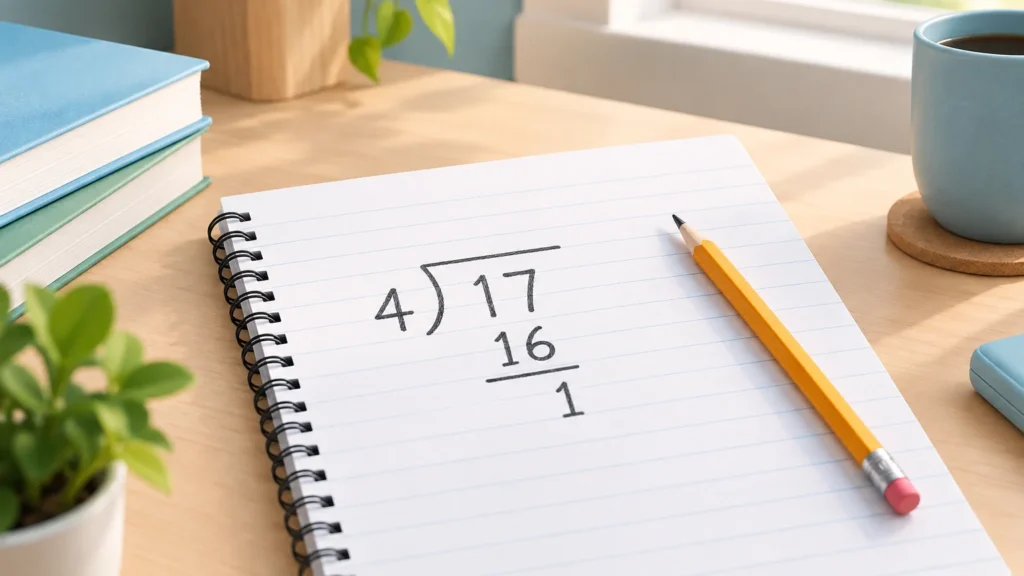
- Set up the division. Write the numerator inside the division bracket and the denominator outside it. For 3/8, that means 8 goes outside and 3 goes inside.
- Add a decimal point and zeros. Since 8 does not go into 3, place a decimal point after the 3 and add a zero. Now you are dividing 30 by 8.
- Divide and bring down. 8 goes into 30 three times (24), leaving 6. Bring down another zero to get 60, and 8 goes into 60 seven times (56).
- Stop when the remainder is zero. Keep adding zeros until nothing is left. Here, 3/8 = 0.375.
Common Fractions and Their Decimal Equivalents
Some fractions show up again and again in recipes, tool measurements and everyday math. Knowing their decimal values by heart saves time. The table below lists the ones you will use most, with values rounded for easy reading.
| Fraction | Decimal | Common use |
|---|---|---|
| 1/2 | 0.5 | Half a cup or half an inch |
| 1/4 | 0.25 | Quarter cup or quarter teaspoon |
| 3/4 | 0.75 | Three-quarters of a cup |
| 1/8 | 0.125 | Eighth of an inch on a tape measure |
| 1/3 | 0.333... | A third of a cup, a repeating decimal |
Handling Repeating Decimals and Mixed Numbers
Some fractions never end when you convert them. The digits keep repeating in a pattern, like 1/3 becoming 0.333 and so on. Mark the repeating part with a bar over the digit or write three dots after it. For practical work, round to the place value your task needs, such as two or three decimal places. Look at the digit just past your cutoff: if it is 5 or more, round up; otherwise, keep the digits as they are.
A mixed number has a whole number plus a fraction, like 2 1/3. Keep the whole number as is, convert the fraction part with the numerator divided by the denominator, and add the two results together. So 2 1/3 becomes 2 + 0.333, which is about 2.33. Here are the steps:
- Set the whole number aside.
- Divide the numerator by the denominator.
- Add the result to the whole number.
Key Takeaways
- To convert a fraction to a decimal, divide the numerator by the denominator.
- Some fractions, like 1/2 or 3/4, end cleanly, while others, like 1/3, repeat forever.
- Memorizing a few common fractions, such as 1/4 and 1/8, makes everyday math faster.
- Mixed numbers convert by keeping the whole number and converting the fractional part.
Frequently Asked Questions About Fraction to Decimal
What is Fraction to Decimal?
Fraction to Decimal is the process of rewriting a fraction as a decimal number. You take the top number, called the numerator, and divide it by the bottom number, called the denominator. The result shows the same value in base-ten form, which is often easier to compare, measure, or enter into a calculator.
How does Fraction to Decimal work?
Divide the numerator by the denominator using long division or a calculator. For example, 3/8 becomes 3 divided by 8, which equals 0.375. If the division ends, you have an exact decimal. If the digits repeat, you have a repeating decimal, which you can round to the place value you need.
Is Fraction to Decimal worth it?
Yes, for most practical tasks. Decimals are easier to add, subtract, compare, and use in money, measurements, and spreadsheets. Converting also helps you check whether a fraction is larger or smaller than another quickly. For exact work, keep the fraction, since rounded decimals can lose precision.
What should I know before trying Fraction to Decimal?
Know which number is the numerator and which is the denominator, because reversing them gives the wrong answer. A denominator of zero is undefined. Expect some fractions to produce repeating decimals, and decide how many decimal places you need before rounding. Always double-check important results with a calculator or the source material.
How do you convert a fraction with a repeating decimal result?
Divide the numerator by the denominator using long division until a remainder repeats. The repeating digits can be marked with a bar over them, such as 1/3 = 0.3 with a bar over the 3. Fractions whose denominators contain only factors of 2 and 5 always give terminating decimals, while others may repeat.
References & Further Reading
- Khan Academy – Khan Academy
- National Institute of Standards and Technology – NIST
About This Article
This guide was written with AI assistance from publicly available information. Prices, nutrition values and availability can change, so confirm important details with the official source before you decide.
Pingback: Inequality Solver: Step-by-Step Guide
Pingback: Decimal to Fraction: Easy Step-by-Step Guide
Pingback: Simplify Fractions Step by Step | Easy Guide