
Equivalent fractions look different but have the same value. Fill in the compare box to check whether two fractions are equal.
Equivalent Fractions can look confusing when two fractions have different numbers but still represent the same amount, like 1/2 and 2/4. If you have ever wondered how that works or how to check it yourself, this guide walks you through it step by step.
What Are Equivalent Fractions?
Equivalent fractions are different fractions that name the same amount. Picture a pizza cut into 2 equal slices. Taking 1 slice means you have 1/2 of the pizza. Cut that same pizza into 4 equal slices, and taking 2 of them still covers exactly half. So 1/2 and 2/4 are equivalent fractions: the numbers look different, but the amount is identical. A fraction bar works the same way. Line up a bar split in half with one split in quarters, and the shaded halves match the shaded quarters.
How to Find Equivalent Fractions
You can find an equivalent fraction by multiplying or dividing both the top and bottom numbers by the same non-zero number. Because you change both parts equally, the value stays the same while the fraction looks different.
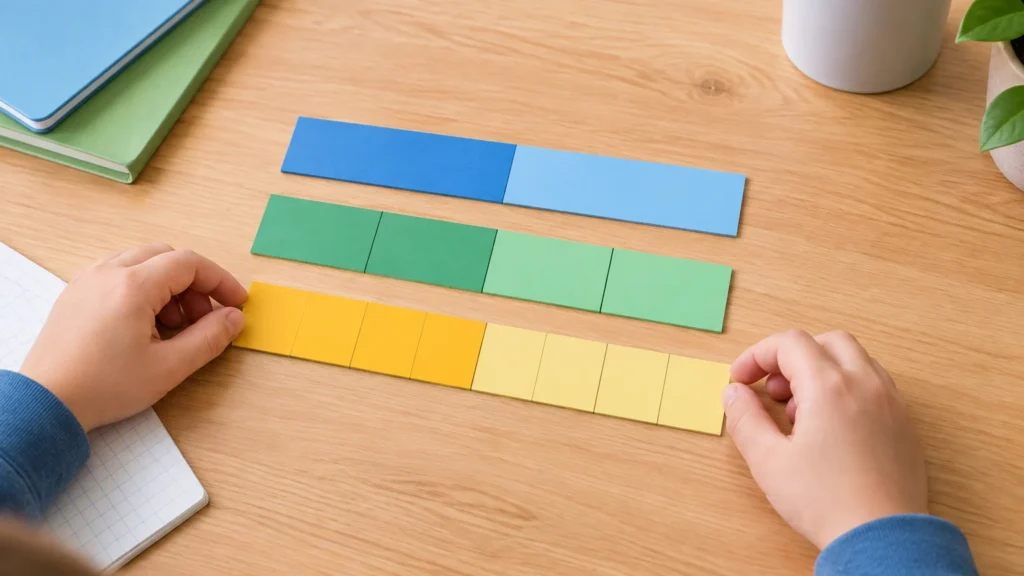
- Pick a multiplier. Choose any whole number other than zero, such as 2, 3, or 4.
- Multiply the numerator. Multiply the top number by your chosen number.
- Multiply the denominator. Multiply the bottom number by the same number.
- Check the result. Compare the new fraction to the original using fraction bars or a chart to confirm they match.
Equivalent Fractions Examples
Seeing a few pairs side by side makes the idea click. Each fraction in the table below names the same amount of a whole, even though the numbers look different.
| Fraction | Multiply by | Equivalent fraction |
|---|---|---|
| 1/2 | 2/2 | 2/4 |
| 1/2 | 3/3 | 3/6 |
| 1/2 | 4/4 | 4/8 |
| 3/4 | 2/2 | 6/8 |
Tips for Simplifying Fractions
To simplify a fraction, divide the numerator and denominator by their greatest common factor (GCF). This gives the fraction's simplest form, where no number other than 1 divides both parts evenly. For example, 6/8 becomes 3/4 after dividing both numbers by 2. Keep these tips in mind:
- List the factors of the numerator and denominator to spot the GCF.
- Divide both parts by the same number, never just one.
- Check that the result cannot be reduced any further.
Need more step-by-step practice? Try this guide: Simplify Fractions: A Friendly Step-by-Step Guide.
Key Takeaways
- Equivalent fractions name the same amount, even though their numerators and denominators look different.
- Multiply or divide the numerator and denominator by the same non-zero number to create an equivalent fraction.
- A fraction is in simplest form when its numerator and denominator share no common factor other than 1.
- Practice with fraction bars and an equivalent fraction chart makes the pattern easier to see and remember.
Frequently Asked Questions About Equivalent Fractions
How do you know if two fractions are equivalent?
Two fractions are equivalent when they represent the same value. One quick check is to cross-multiply: if the numerator of the first times the denominator of the second equals the denominator of the first times the numerator of the second, they match. You can also simplify both fractions and see if they reach the same simplest form.
Can you have more than one equivalent fraction for the same number?
Yes, a single value has infinitely many equivalent fractions. For example, 1/2 equals 2/4, 3/6, 4/8, and so on. You create each one by multiplying the numerator and denominator by the same non-zero whole number, so the value stays exactly the same.
What is the simplest form of a fraction?
A fraction is in simplest form when its numerator and denominator have no common factor except 1. To reach it, divide both parts by their greatest common factor. For instance, 6/8 becomes 3/4 once you divide both numbers by 2.
Why are equivalent fractions important in math class?
Equivalent fractions are the foundation for adding, subtracting, and comparing fractions with different denominators. They help students see that different-looking fractions can share one value. Mastering them also prepares learners for ratios, decimals, and percentages later on.
References & Further Reading
- Common Core State Standards Initiative – Common Core State Standards Initiative
- National Council of Teachers of Mathematics – NCTM
About This Article
This guide was written with AI assistance from publicly available information. Prices, nutrition values and availability can change, so confirm important details with the official source before you decide.
Pingback: Decimal to Fraction: Easy Step-by-Step Guide
Pingback: Fraction to Decimal: Easy Step-by-Step Guide