
For repeating decimals put the repeating digits in brackets: 0.(3) means 0.333… and 0.1(6) means 0.1666…
Decimal to Fraction is a skill that comes up in homework, cooking and measuring, and many people freeze when a number like 0.75 needs to be written as a fraction. This guide walks through the steps in plain language so you can convert any decimal with confidence.
Why Convert Decimals to Fractions?
Decimals and fractions show the same values in different forms. Fractions often make more sense in everyday American life. A recipe that calls for three-quarters of a cup, or a board cut to five-eighths of an inch, is easier to measure with a standard tape or measuring cup than a decimal would be. Carpenters, machinists, and home cooks all rely on fractions for this reason. Converting a decimal to a fraction is the fastest way to turn a calculator result into a measurement you can actually use. Once you know the method, you can handle any decimal to fraction problem with confidence.
How to Convert a Terminating Decimal to a Fraction
A terminating decimal ends after a finite number of digits, like 0.75 or 0.4. To turn one into a fraction, write the digits as the numerator and use the matching power of ten as the denominator. The number of digits after the decimal point tells you which place value to use.
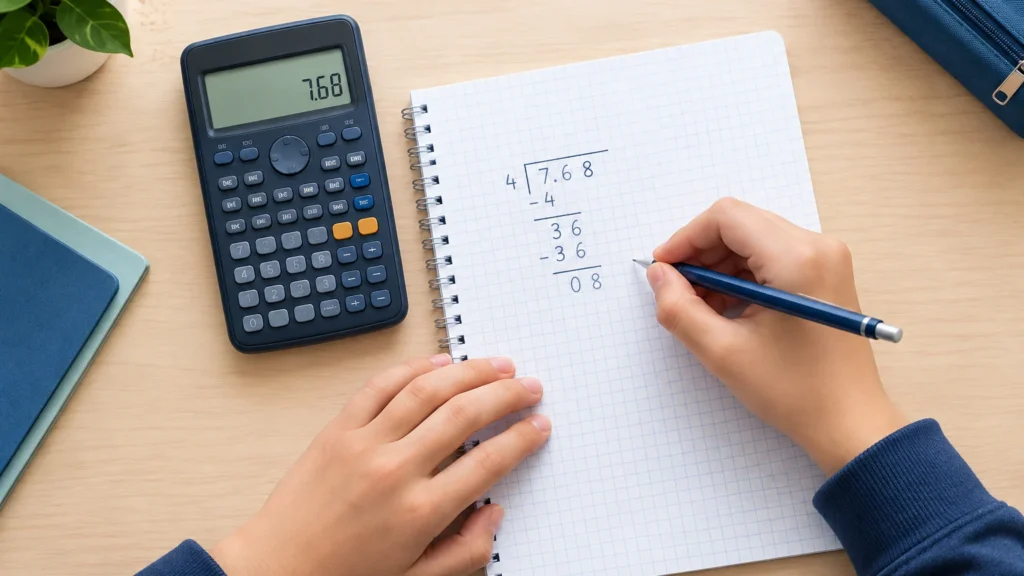
- Count the decimal places. Note how many digits sit to the right of the decimal point.
- Write the fraction. Drop the decimal point to make the numerator, and use 10, 100, 1,000 and so on as the denominator.
- Find the greatest common divisor. Find the largest number that divides both the numerator and denominator evenly.
- Simplify. Divide both parts by that number to get the reduced fraction.
For example, 0.75 has two decimal places, so it becomes 75/100. The greatest common divisor is 25, which leaves 3/4.
Converting Repeating Decimals and Mixed Numbers
Repeating decimals, like 0.333..., look harder to convert, but a little algebra handles them neatly. You can also turn the result into a mixed number when the value is greater than one. Here is the method for a repeating decimal such as 0.6 with the 6 repeating:
- Name the number. Let x equal the repeating decimal, so x = 0.666...
- Shift the decimal. Multiply by 10 for one repeating digit, so 10x = 6.666...
- Subtract to remove the repeat. Subtract the first equation from the second: 9x = 6, so x = 6/9.
- Simplify and convert to a mixed number if needed. Divide the numerator and denominator by their greatest common divisor to get 2/3. For a value like 2.5 repeating, keep the whole number separate and write the fraction part as a mixed number.
Always check your answer by dividing the fraction back into a decimal to confirm it matches.
Common Decimal to Fraction Conversions
Some decimals show up again and again, so it helps to know their fraction forms by heart. The table below lists the most common ones. Each fraction is already simplified, so you can use these values directly in homework, recipes and measurements.
| Decimal | Fraction | Simplified Form |
|---|---|---|
| 0.5 | 5/10 | 1/2 |
| 0.25 | 25/100 | 1/4 |
| 0.75 | 75/100 | 3/4 |
| 0.2 | 2/10 | 1/5 |
| 0.125 | 125/1000 | 1/8 |
| 0.333... | 1/3 | 1/3 |
| 0.666... | 2/3 | 2/3 |
Key Takeaways
- A decimal becomes a fraction by writing its digits over the matching place value, such as 0.75 as 75/100.
- Simplify the result by dividing the numerator and denominator by their greatest common divisor.
- Repeating decimals need an algebra step, while mixed numbers keep the whole-number part separate.
- Memorizing a few common conversions, like 0.5 and 0.25, speeds up everyday math.
Frequently Asked Questions About Decimal to Fraction
What is Decimal to Fraction?
Decimal to Fraction is the process of rewriting a decimal number as a fraction with a numerator and a denominator. The value stays the same, but the form changes. For example, 0.5 and 1/2 represent the same amount. Most people do this by reading the decimal's place value and simplifying the result.
How does Decimal to Fraction work?
Count the digits after the decimal point and use that count to choose a power of ten, such as 10, 100 or 1000. Write the digits without the decimal point as the numerator and the power of ten as the denominator. Then divide both numbers by their greatest common divisor to simplify the fraction fully.
Is Decimal to Fraction worth it?
It is worth learning because fractions are easier to use in many everyday settings, such as cooking, carpentry and measuring. Fractions also show exact values that rounded decimals can hide. A quick conversion helps you compare amounts and spot patterns in math problems.
What should I know before trying Decimal to Fraction?
Know your place values, from tenths to thousandths, and be comfortable finding a greatest common divisor. Expect that repeating decimals need a different method than terminating ones. Check your answer by dividing the numerator by the denominator to confirm you get the original decimal back.
How do you convert a repeating decimal like 0.333... into a fraction?
Write the repeating part as x, multiply x by a power of 10 that shifts one full repeating cycle to the left of the decimal point, then subtract the original equation to eliminate the repeat. For 0.333..., multiplying by 10 and subtracting gives 9x = 3, so x = 1/3. Always simplify the result to lowest terms.
References & Further Reading
- Khan Academy – Khan Academy
- National Institute of Standards and Technology – NIST
About This Article
This guide was written with AI assistance from publicly available information. Prices, nutrition values and availability can change, so confirm important details with the official source before you decide.
Pingback: Fraction to Decimal: Easy Step-by-Step Guide