
Leave the numerator and denominator empty for a plain whole number. Use a minus sign in the whole-number box for negatives.
A Mixed Number Calculator takes the guesswork out of working with numbers like 2 3/4 or 1 1/2. If you have ever stared at a homework problem that combines whole numbers and fractions, or tried to add two recipe amounts without messing up the denominators, you know how easy it is to make a small slip. This guide shows you how to get a fast, accurate answer and how to check it yourself.
What Is a Mixed Number Calculator?
This online tool adds, subtracts, multiplies, divides and simplifies numbers that combine a whole number with a fraction, such as 2 1/3. You type in the mixed numbers, and it returns the answer as a mixed number, an improper fraction or a decimal, usually in simplest form. Students use it to check homework, parents use it to help with math practice, and cooks and tradespeople use it when measurements like 1 3/4 cups or 2 1/2 inches need quick arithmetic. A basic calculator handles decimals well but can’t keep the whole-number-and-fraction structure, so you often have to convert by hand. This kind of tool keeps everything in fraction form for you.
How to Use a Mixed Number Calculator
Using a calculator for mixed numbers takes less than a minute once you know the layout. Most tools ask for a whole number, a numerator and a denominator for each value, so you enter three small pieces per number.
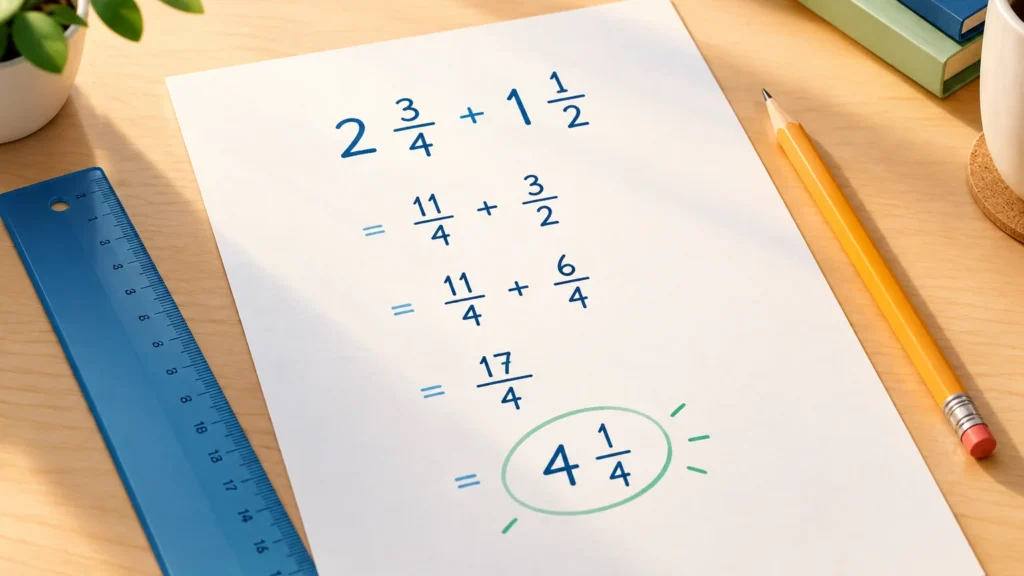
- Enter the first number. Type the whole number, then the numerator and the denominator. For 2 3/4, that means 2, 3 and 4.
- Choose your operation. Select addition, subtraction, multiplication or division before you enter the second number.
- Enter the second number. Fill in its whole number, numerator and denominator the same way.
- Read the result. Check whether the answer appears as a mixed number, an improper fraction or both, and confirm it is simplified.
Mixed Numbers vs. Improper Fractions
A mixed number and an improper fraction both describe the same amount. A mixed number pairs a whole number with a proper fraction, such as 2 1/3. An improper fraction keeps everything in one fraction, with a numerator larger than the denominator, such as 7/3. To convert a mixed number, multiply the whole number by the denominator, add the numerator, and keep the same denominator: 2 × 3 + 1 = 7, so 2 1/3 = 7/3. To go the other way, divide the numerator by the denominator: 7 ÷ 3 gives 2 remainder 1, so 7/3 = 2 1/3.
| Form | Example | Best used when |
|---|---|---|
| Mixed number | 2 1/3 | Reading quantities, measuring recipes or describing lengths |
| Improper fraction | 7/3 | Multiplying, dividing or adding fractions with different denominators |
Use the mixed form when you want to see the size at a glance. Switch to the improper form when you need to multiply or divide, since it is usually easier to work with.
Common Mistakes When Adding and Subtracting Mixed Numbers
Most errors with mixed numbers come from skipping a step. The most common one is adding the numerators and denominators straight across without finding a common denominator first. Borrowing is the other trouble spot when you subtract, because it’s easy to forget to add the borrowed whole back into the fraction. A quick check with a calculator shows you exactly where your work went off track.
- Adding denominators together instead of finding a common one
- Forgetting to carry or borrow between the whole number and the fraction
- Leaving the answer as an improper fraction when a mixed number is expected
- Skipping the final step of simplifying fractions
Key Takeaways
- A mixed number pairs a whole number with a proper fraction, and this tool handles the arithmetic for you.
- To add or subtract mixed numbers by hand, find a common denominator first, then combine the whole numbers and the fractions separately.
- Converting to an improper fraction makes multiplying and dividing easier, and converting back gives you a clean, simplified answer.
- Watch for borrowing when subtracting and for forgetting to simplify, since these two slips cause most wrong answers.
Frequently Asked Questions About Mixed Number Calculator
What is Mixed Number Calculator?
This online tool adds, subtracts, multiplies or divides numbers written as a whole number plus a fraction. You enter the mixed numbers, choose the operation, and it returns a simplified result, usually shown as a mixed number and an improper fraction.
How does Mixed Number Calculator work?
The calculator converts each mixed number into an improper fraction, performs the chosen operation using common denominators where needed, then simplifies the result. It converts the answer back into a mixed number so it’s easy to read. Most tools show each step so you can follow the logic.
Is Mixed Number Calculator worth it?
Yes, if you want quick, accurate answers or a way to check your homework. It saves time on tricky denominators and reduces arithmetic errors. It works best alongside understanding the method, so use it to confirm your own work rather than replacing practice entirely.
What should I know before trying Mixed Number Calculator?
Enter each part carefully: the whole number, the numerator and the denominator. Make sure the denominator isn’t zero and that the fraction part is proper where the tool expects it. Check whether the calculator simplifies automatically, and confirm the format of the answer you need for class or work.
How do I convert a mixed number to an improper fraction by hand?
Multiply the whole number by the denominator, add the numerator, and place that total over the original denominator. For example, 2 3/4 becomes (2 × 4 + 3)/4, which equals 11/4. The method works for any positive mixed number and is a common step before adding or subtracting.
References & Further Reading
- Khan Academy – Khan Academy
- National Council of Teachers of Mathematics – NCTM
About This Article
This guide was written with AI assistance from publicly available information. Prices, nutrition values and availability can change, so confirm important details with the official source before you decide.
Pingback: Fraction Calculator: Add, Subtract & Simplify