
Solves ax² + bx + c = 0. Real and complex roots are both shown.
A Quadratic Equation Solver finds the roots of any equation written as ax² + bx + c = 0, which is the step most students and homeowners get stuck on. If you have a parabola problem due tomorrow or a area question that turns into a squared term, you need the answer fast and you need to understand how it was reached.
What a Quadratic Equation Solver Does
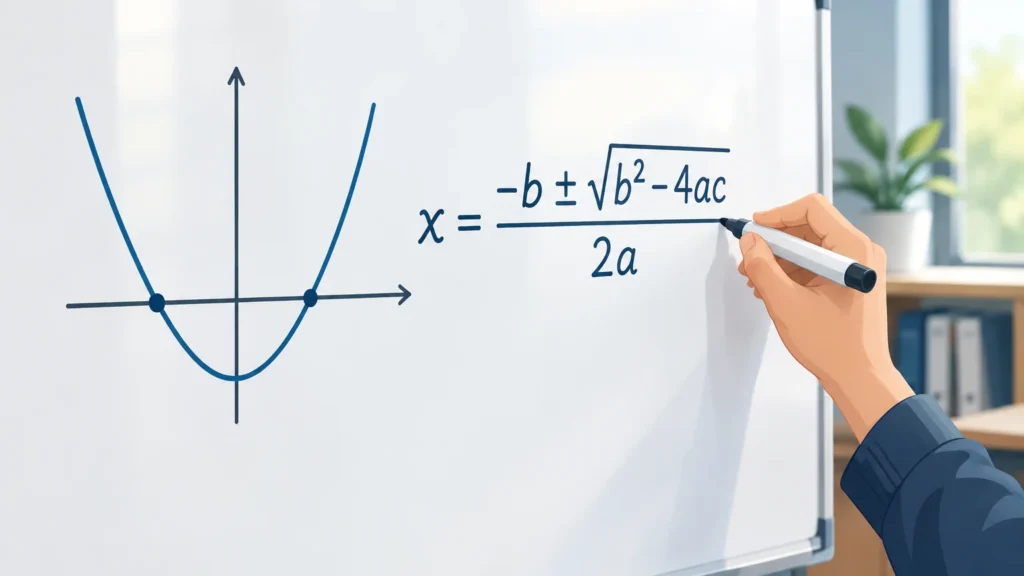
A quadratic equation is an equation where the highest power of the variable is two, usually written as ax² + bx + c = 0. A Quadratic Equation Solver takes the values of a, b and c and calculates the roots, which are the x-values where the equation equals zero. On a graph, these roots are the points where the parabola crosses the x-axis. A solver saves real time when you have messy decimals, large coefficients or several equations to check. Working through the algebra by hand still matters for learning, so use a solver to confirm your answers rather than skip the practice.
The Quadratic Formula Behind the Solver
Every quadratic equation can be written in standard form: ax² + bx + c = 0, where a, b, and c are numbers and a is not zero. The quadratic formula, x = (−b ± √(b² − 4ac)) / 2a, gives the roots directly from those three coefficients. The part under the square root, b² − 4ac, is the discriminant. It tells you whether the parabola crosses the x-axis twice, once, or not at all.
- Identify the coefficients. Rewrite the equation so one side equals zero, then read off a, b, and c, including their signs.
- Calculate the discriminant. Square b, multiply 4, a, and c together, then subtract the product from b².
- Apply the formula. Substitute the values into −b ± √(discriminant), divided by 2a.
- Simplify both roots. Solve once with the plus sign and once with the minus sign to get the two answers.
Quadratic Equation Solver Methods Compared
Four methods can get you to the roots of a quadratic equation, and each one shines in different situations. Factoring is quickest when the numbers cooperate. Completing the square builds understanding of where the formula comes from. The quadratic formula works on every quadratic, even messy ones. Graphing lets you see the roots as the points where a parabola crosses the x-axis. Use the table below to pick the right tool for your problem.
| Method | Works best when | Main drawback |
|---|---|---|
| Factoring | Coefficients are small whole numbers with clean factor pairs | Fails or takes too long when factors are hard to spot |
| Completing the square | You want to see the structure or derive the vertex form | Involves more arithmetic steps |
| Quadratic formula | Any quadratic, especially with decimals or irrational roots | Easy to make small sign or arithmetic errors |
| Graphing | You need a visual check or an approximate answer | Exact values are hard to read off a graph |
How to Solve a Quadratic Equation Step by Step
Let’s work through x² − 5x + 6 = 0. Here a = 1, b = −5, and c = 6. First, compute the discriminant, b² − 4ac = 25 − 24 = 1. Because it is positive, the equation has two real roots. Substituting into the formula gives x = (5 ± 1) / 2, so x = 3 or x = 2. Checking x = 3 in the original equation gives 9 − 15 + 6 = 0, which confirms it.
- Write in standard form. Move every term to one side so the equation reads ax² + bx + c = 0.
- Find the discriminant. Calculate b² − 4ac. A negative result means the roots are complex.
- Apply the formula. Substitute a, b, and c into x = (−b ± √discriminant) / 2a.
- Check by substitution. Plug each root back into the original equation to confirm it equals zero.
Key Takeaways
- A quadratic equation solver finds the roots, the x-values where a parabola crosses the x-axis.
- The quadratic formula works for every quadratic equation, and the discriminant tells you how many real roots to expect.
- Free online tools can check your work, but knowing the steps helps you catch mistakes.
- Always substitute your answers back into the original equation to confirm they are correct.
Frequently Asked Questions About Quadratic Equation Solver
Can a quadratic equation have no real solutions?
Yes. When the discriminant is negative, the parabola never touches the x-axis, so the equation has no real solutions. It does have two complex solutions, which are useful in more advanced algebra and engineering courses.
What is the discriminant and why does it matter?
The discriminant is the part of the quadratic formula under the square root sign, written as b² − 4ac. It tells you the number of real roots: two if it is positive, one if it is zero, and none if it is negative. Checking it first saves time.
Is there a free quadratic equation solver I can use online?
Yes. Several free tools, including Wolfram Alpha and Khan Academy’s practice resources, can solve quadratic equations for you. Many of them also show steps, which makes them useful for studying. Check each site’s current features, since offerings change over time.
How do I know if my quadratic solver answer is correct?
Plug each root back into the original equation and simplify. If both sides match, the answer is correct. You can also graph the equation and confirm the parabola crosses the x-axis at your roots.
What is the difference between factoring and using the quadratic formula to solve an equation?
Factoring rewrites the equation as a product of two binomials and sets each factor to zero, which is quick when the roots are integers or simple fractions. The quadratic formula works for every quadratic, including messy or irrational roots, so it is the more reliable general method when factoring is hard to spot.
References & Further Reading
- Khan Academy – Khan Academy
- Wolfram Alpha – Wolfram Alpha
- National Institute of Standards and Technology – NIST
About This Article
This guide was written with AI assistance from publicly available information. Prices, nutrition values and availability can change, so confirm important details with the official source before you decide.
Pingback: Exponent and Root Calculator – Free Online Tool
Pingback: Linear Equation Solver: Step-by-Step Guide